Showing posts with label Literature. Show all posts

Friday, July 11, 2008

UNDERGROUND FILM-FLAM

It is with dismay that we note the premiere of Hollywoodland’s adaptation of H.G. Verne’s natural history text Journey to the Center of the Earth in 80 Days. Ever since the dawn of cinema, in such films as The Island of Dr. Caligari, the Show-Me Business has displayed a poor track record when it comes to adapting non-fiction books to the screen. These so called Dream Manufacturers would do much better to stick with such escapist, popping-corn fantasy fare as The Greatest Story Ever Told, Fahrenheit 911, or Munich.

That being said, one of the things that makes the Center of Earth such an unpromising setting for a feature film is that it is, in a word, boringasallhell. This is partly because most people expect the Center of the Earth to actually BE Hell, and this expectation is dead set on disappointment. Not only is Hell itself, yes, boring, it isn’t even located at the Center of the Earth: the historical basis for the Christian vision of the sinners’ afterlife is actually the Saturnian moon Enceladus, which originally orbited around the earth until it was pushed out by our current moon during a celestial 372 A.D. power grab.

The actual Center of the Earth, as we doubt many people need to be told, consists of little more than white-hot, slug-like creatures known collectively as magma. Retaining much of the heat of the explosion that downgraded the Sun to its current, dwarfish size – in the process expelling the mineral nuggets that would later accrue into the planets – magma don’t really have much to offer the world above. They tend to stick to their own kind, and, when they’re not huddling close to their fellows for extra, redundant warmth (they’re addicted to the stuff), they have a reputation as cruel practical jokers. They find nothing funnier than to cut a trick a hole in the floor (aka the Earth’s Crust) and watch their unsuspecting friends cascade down it and harden in the cold air outside – a phenomena known to English-speaking humans (among others) as the Volcano.

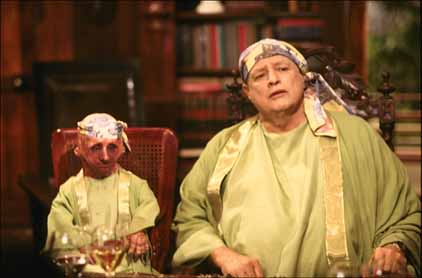
So if you’re going to use your hard-earned guilders to see any film this weekend, make it the biopic Hellboy II, starring one of our most distinguished actors, Sir Ron Coleman. More entertaining, and more historically accurate to boot.

Friday, April 13, 2007

GONNEGUT

Yesterday newspapers and websites around the globe reported the sad news of the passing of one of the finest investigative journalists of the Twentieth Century, Kurt Vonnegut. Though he never won the Pulitzer Prize, his insightful reporting about the curious byways of the postmodern world shaped the minds and thoughts of a generation, and then some.

A humble Indiana farmboy, he was an undistinguished Pontiac dealer until he was taken prisoner as an American soldier in Germany during World War II, at which time he was forced to aid Werner Heisenberg in his time-travel experiments for the Third Reich. Though ultimately aborted as “too freaky and evil even for Nazis,” the experiments left an indelible mark on young Vonnegut, who returned to America determined to write about the world’s weirder ills.

Following in the footsteps of Sinclair Lewis’s The Jungle, Vonnegut blazed forth on the literary scene with his unblinking expose on the meatpacking industry, Slaughterhouse-Five. But important work both preceded and followed this achievement, including his coverage of the invention of ice-nine, his interviews with literature Nobelist Kilgore Trout, and a biography of WWII-era double agent Howard W. Campbell, Jr.

Though many refer to his books as “novels,” this is merely a matter of style – it’s difficult to deny the bedrock of cold, hard fact upon which they were built. Even when his subjects were as outrĂ© as Tralfamadorian race, the fringe religion of Bokononism, or the mythical islands of the Galapagos, he applied the same wry wit and humanist viewpoint that made him a star of the counterculture and a bane of the mainstream media. Though his output slowed in later years, his fiercely independent viewpoint remained strong, even as he began to focus his talents on such fiction offerings as his final book, 2005’s Man Without a Country.

Few voices today dare to tell the truth in terms as brisk and bold as those employed by Vonnegut. Without him, reality will be much harder to come by.

Thursday, March 8, 2007

POST MO(DERN)RTEM

The possibility exists that at least one person out there had some form of thought, sentiment, opinion, position or brief, peripheral moment of awareness regarding the death Tuesday of French philosopher Jean Baudrillard. However, since “French” and “philosopher” have been voted the two words most likely to put an American citizen to sleep immediately upon utterance, it’s unlikely that many have taken the time and effort to untangle the various ontological knots that are his legacy.

Best known for devising the concept of the simulacrum and inventing the geodesic dome, Baudrillard spent years building a reputation as one of the densest and most paradoxical of modern thinkers. His theory that the world as we know it has been replaced with a false reality of manufactured image was simplified and adopted by such popular science-fiction films as Soylent Green and The Wedding Singer. But by far the most surprising detail about this man’s life and work is the fact that, like Jesus, he never actually walked the earth.

It’s long been known in the most concentric of literary circles that Baudrillard was a fictional character created by French deconstructionist Jacques Derrida (1930-2004), as the result of a drunken bet that he couldn’t come up with a writer capable of spewing even more garbled theory than himself. This would ordinarily be nothing more than an amusing anecdote in the history of bullshit, but for that the fact that Derrida himself was an invention of French post-structuralist Michel Foucault (1926-1984). As no one else during his lifetime was capable of following his circuitous prose, Foucault concocted Derrida as an imaginary friend, colleague, and occasional gay lover. The conceit stuck, however, and Derrida – like Baudrillard after him – became a notable public figure in his own right.

Foucault himself was the great-grandson of the Marquis de Follard, a 19th-century pedant who appeared throughout the French countryside dispensing phrases of mock wisdom filled with English malapropisms. Little biographical information exists concerning the Marquis, since he was a minor character in Charles Dickens’s little-read 1852 novel A Common Whimmletucket, which followed the adventures of young Horace Whimmletucket as he traversed the Continent pursuing the secret of his mysterious parentage. And since Dickens himself was a speculative creation of the ancient Athenian playwright Aristophanes, well, there you have it.

All of this was not so much predicted by Baudrillard's corpus of learned obfuscation as accurately described after the fact. It takes a simulacrum to know a simulacrum, as the saying may or may not go, and Baudrillard was definitely maybe or maybe not one of them. Rest in peace, man who never was.

Friday, February 16, 2007

I HAVE POSITIVE FEELINGS FOR IKE


These days, President Dwight D. “Honest Ike” Eisenhower is generally considered little more than a relic from the Eisenhower era. Aside from his having coined the phrase “military-industrial complex” (which we are tired of having archly pointed out to us at parties and cabal meetings), little exists in the public sphere to distinguish our nation’s 34th Commander-in-Chief from a moderately intelligent potato, or sack of potatoes.

A trip to the President Dwight D. Eisenhower Presidential Library, in Abilene, Kansas, however, reveals some shockingly unexpected data on the man who, as you may or may not have known, coined the phrase “military-industrial complex.”

Most visitors to the Library are lured by the big-ticket items: Eisenhower’s prize-winning collection of vintage goiter photographs, his autographed first-edition copy of P.D. Eastman’s paean to canine locomotion, Go, Dog, Go!, and the Ark of the Covenant.
But the true treasures of the Library are to be found much deeper within, in a secret chamber that can only be broached with stalwart academic credentials, or crudely forged facsimiles thereof.

In this hidden sanctum, next to Eisenhower’s mummified corpse (and no, we weren’t supposed to take pictures, so ssh!), is an item that threatens to topple popular views of this former snooker champion’s Presidency, and, indeed, the entire decade in which it unfolded.


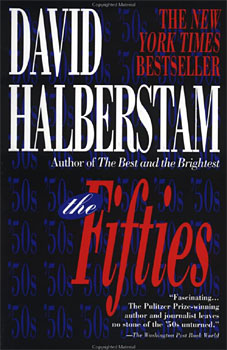
Popular historian David Halberstam’s chronicle of the postwar years was released to the public in 1993. Eisenhower’s dog-eared copy, however, proves that this book was not a saga of hindsight, but, in fact, a work of speculative fiction penned in 1947. Thoroughly digested by the President-to-Be, who became fascinated – nay, obsessed – with the strange revelations found within, it became not a retrospective analysis of, but, in fact, the very template by which the following ten years were forged. The concept behind the hydrogen bomb was mere fantasy before Halberstam (a mere boy of 13 when he wrote the book) anticipated its design in his book. Enamored, Eisenhower made one of his first priorities as President the assignment of chief designers Edward Teller and Stanislaw Ulam to make manifest what had already been written about them. The same pattern resulted in the creation of Elvis, hula hoops, and the Korean War (which technically began before Eisenhower was sworn in, but we know enough about Washington politics not to be surprised by this).

Word of this so-called “paradox” began to leak sometime during the 1970s, when Eisenhower’s former Vice President, Richard Nixon, was looking for a way to evade the scrutiny being leveled against him as a result of the Whitewater Scandal. Halberstam, a notoriously slow writer (he’d been working on The Fifties since 1939), decided to make a few revisions, and would have kept at it for much longer if the Republican Party, enraged by the election of Communist Party candidate Hilary Clinton to the Presidencey in 1992, hadn’t just jerked the thing out of his hands and brought it to press.

We had some excellent photos of some of Eisenhower’s notes and suggestions in the margins of the original manuscript (re: television – “Hey, wouldn’t it be neat if we kept making the screens bigger? And invented subliminal advertising?”), but alas, it turns out there was a video camera installed in the mummy’s empty eye sockets, and we were kicked out, had our camera destroyed before our eyes, and were told never to darken the door of a Presidential Library for as long as we lived. This is why we now wear a fake moustache whenever we go to a Presidential Library.